MERACH
MERACH 440-Pound Capacity Vibration Plate
A higher-capacity MERACH choice for shoppers who need more margin in the stated limit.
An oscillating vibration plate behaves like a controlled seesaw: when the left edge rises, the right edge falls. That side-alternating motion is the defining feature, and it explains why stance width matters more than a long list of preset programs. Before comparing speed counts, shoppers should understand what the platform does beneath the feet.
With both feet on the deck, one side of the pelvis is encouraged upward as the other moves downward. The body answers with rapid changes in ankle, knee, and hip tension. Travel is usually smallest near the center and greater near the edges, so moving the feet wider can increase the mechanical input without touching the controls.
Keep the knees unlocked. A rigid stance can send more movement toward the head, while a small bend lets the lower body absorb it. New users can begin close to the center, use stable support, and widen the stance only after they can hold position without gripping with the toes.
Frequency is the number of cycles per second, expressed in hertz when published. Amplitude is the amount of deck travel. A plate can move quickly through a short path or slowly through a larger path; those experiences are not equivalent. Retail speed numbers are proprietary control steps, so level 30 on one model cannot be matched reliably to level 30 on another.
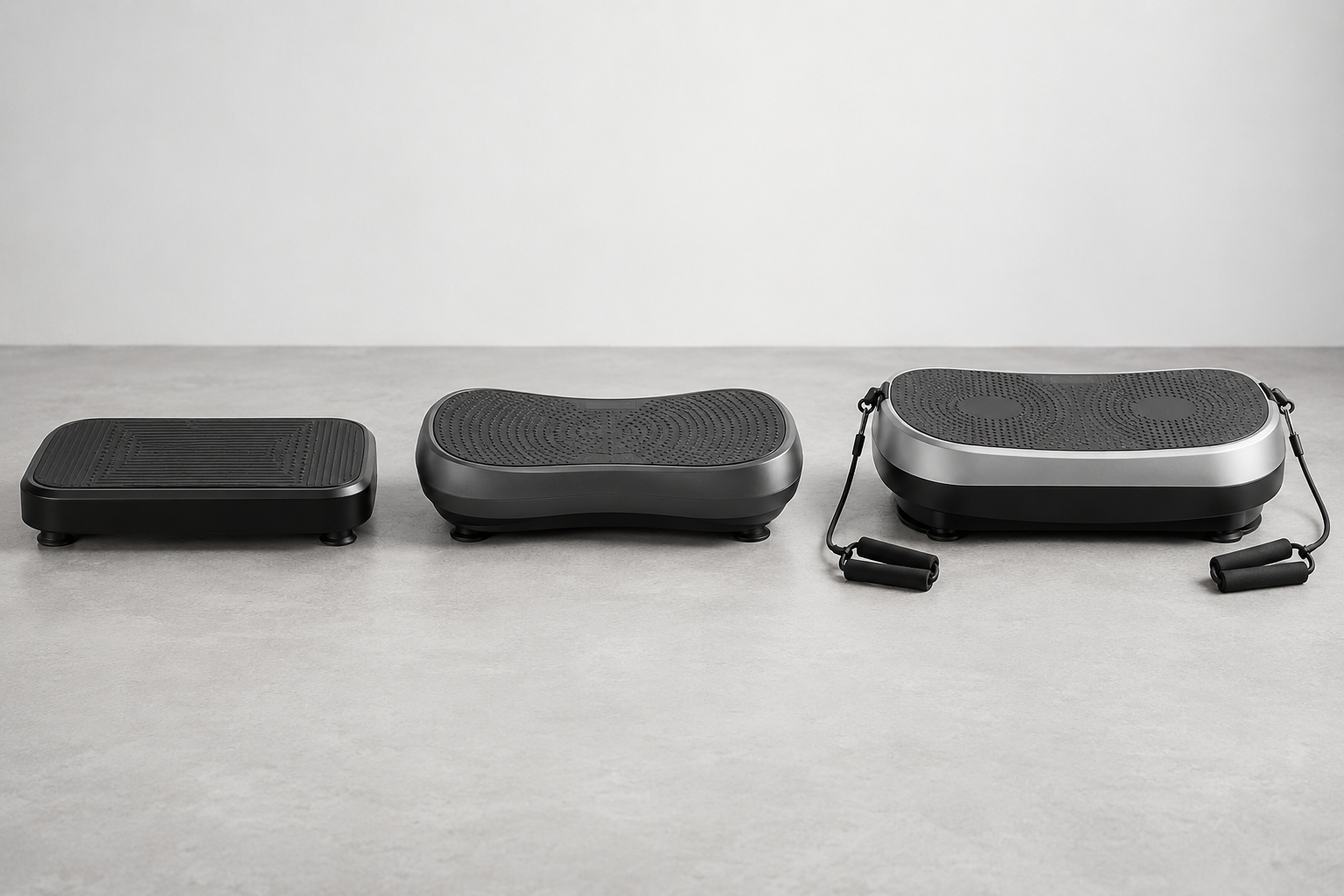
Curved decks complicate the comparison because the standing surface changes angle across its width. Flat platforms offer a more uniform foot surface. Neither shape proves better motor performance. Deck dimensions, usable area, grip, and disclosed motion specifications tell a buyer more.
Oscillating plates suit buyers who want standing sessions, shallow squats, calf raises, split stances, or resistance-band movements on a compact home machine. The alternating pattern often feels intuitive because it resembles weight shifting. It is less attractive when the goal is a specific vertical-vibration protocol calling for known frequency and displacement values.
A wide deck helps users establish a comfortable stance, but width also increases possible travel at the edges. Buyers who need easy storage should check machine weight and grip points, not only footprint. A plate that fits under a bed may still be awkward to lift every day.
Look for a reachable stop control, a remote that works from the planned posture, stable feet, clear instructions, and enough capacity margin. Resistance bands add options, but their attachment points and replacement availability matter. Bluetooth speakers are secondary if the deck rocks or the controls are hard to read.
Noise should be judged through the floor as well as in the room. A dense equipment mat may reduce transmitted buzz on hard flooring, whereas a thick rug can let the base wobble. During the return window, test the exact room, stance, and time of day in which the plate will be used.
Use the first several sessions to learn the machine rather than chase its maximum setting. Begin with the plate on a firm, level surface, feet near the middle, knees relaxed, and a support within reach. Note whether the motor starts smoothly, whether the base stays planted, and whether the display remains readable from the normal standing position. Move the feet outward in small steps on later sessions so the effect of stance width is easy to distinguish from a change in controller level.
Try the positions that justified the purchase. A shallow squat needs enough front-to-back deck depth for the feet to remain fully supported. A calf raise needs secure tread at the chosen stance. Resistance-band work requires anchors that keep the cords away from sharp shell edges. For hands-on-deck exercises, confirm that the usable surface is broad and comfortable for the wrists. A machine can be excellent for standing and still be poorly shaped for planks or push-ups.
Keep a short record of mode, level, stance, session length, and room. This creates a personal reference without pretending the numbers transfer to another model. Stop and reassess if the plate walks across the floor, develops a new mechanical rattle, or feels unpredictable at low settings. Those observations are more valuable during the return period than testing a maximum speed that may never belong in the routine.
As an Amazon Associate, we may earn from qualifying purchases.
A higher-capacity MERACH choice for shoppers who need more margin in the stated limit.
Choose an oscillating plate when side-alternating motion, adjustable stance, and compact home use fit the routine. Compare real deck space, machine mass, capacity margin, controls, and disclosed frequency or amplitude before comparing the number printed beside the speed button.
Continue the Oscillating Vibration Plates Explained decision in the full product catalog, brand directory, or vibration plate finder.