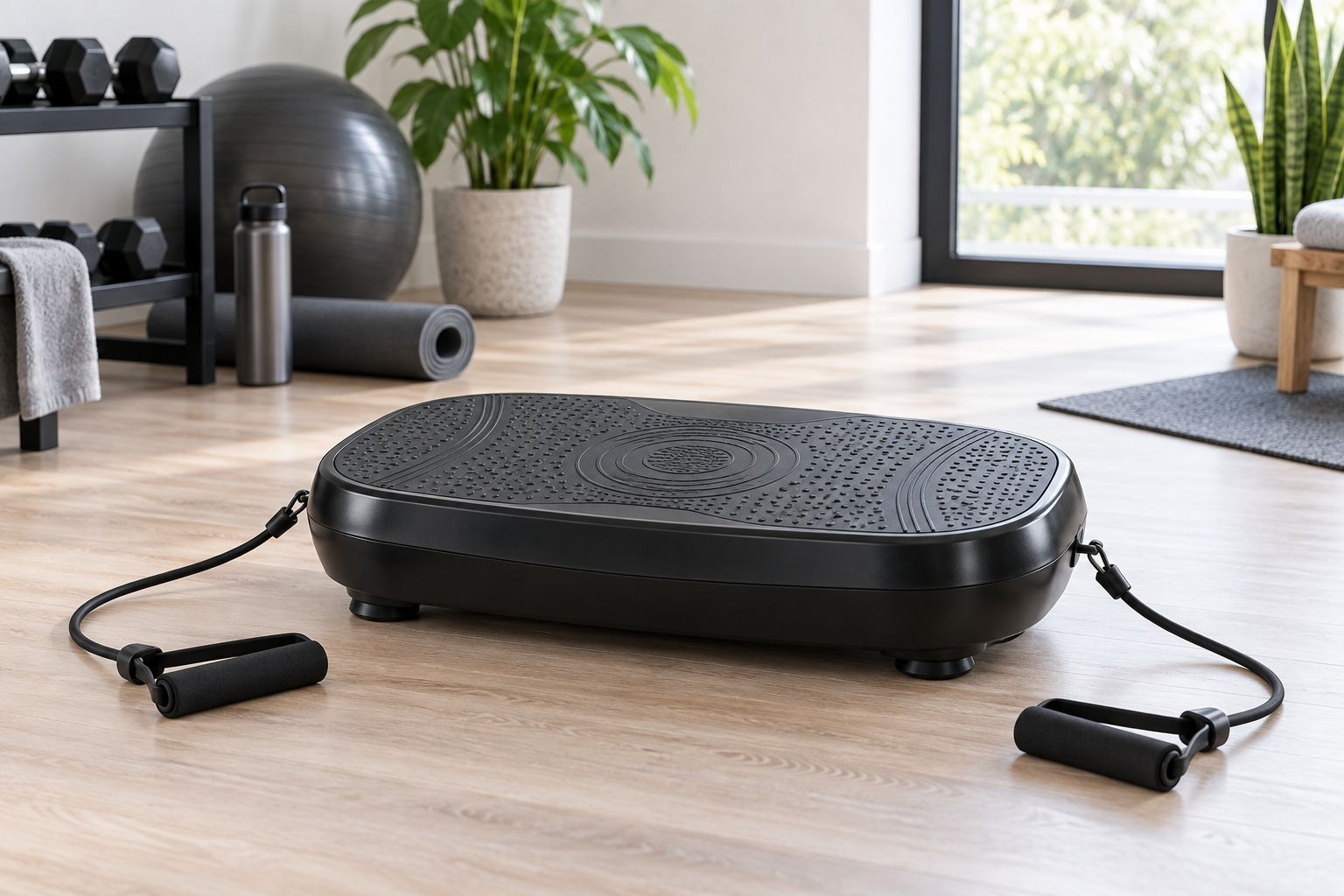
Power Plate
Power Plate MOVE Professional Vibration Platform
An upright professional-style platform for buyers who value integrated hand support.
If a vibration plate shakes the floor, stop increasing the speed and find the transmission path. The machine may be rocking on uneven feet, exciting a flexible section of flooring, touching the wall, or sitting on padding that behaves like a spring. The goal is not to smother all motion with soft material. It is to keep the plate level while reducing how much energy enters the building.
Turn the plate off and remove loose accessories from the deck and nearby furniture. Check underneath for grit, a folded mat edge, or one foot on a floor seam. Press opposite corners; any rocking must be corrected before powered testing. Make sure the housing and cord do not touch a wall or cabinet.
If the manual permits unloaded operation, run the lowest setting for ten seconds while watching from a safe position. Then repeat with a centered soft-knee stance. Note whether shaking begins only under body weight, at a certain speed, or with a wide stance. Stop if the machine walks, knocks, or tilts.
Place removable tape at the corners to reveal walking or rotation. A plate that moves relative to the tape has a grip, foot, level, or mechanical problem. If the plate stays still but objects across the room rattle, the floor is carrying vibration. Ask someone in an adjacent or lower room to identify where it is strongest.
Change one factor at a time. Move loose objects first, then test a dense single-piece equipment mat, then test a location closer to a load-bearing wall. Keep the same speed, stance, and duration for each comparison. Stacking foam, carpet scraps, and rubber destroys the baseline and can introduce unsafe sway.
Clean rubber feet and replace a worn or missing one with the specified part. On a firm finished floor, use a dense non-staining mat that supports every foot. On compliant carpet, follow the manufacturer’s surface guidance; a rigid base may be needed if allowed. Whatever sits underneath must remain flat under load and must not cover ventilation.
A flexible room center may amplify movement. Relocating a few feet toward structural support can make a larger difference than choosing a thicker mat. Avoid bridging two flooring materials or placing half the machine on a rug. If the floor is visibly deflecting, damaged, or structurally uncertain, stop and obtain qualified advice.
Uneven motion, a platform that strikes the housing, grinding, burning odor, or sudden changes in speed are not room-acoustics issues. Unplug the plate and inspect accessible fasteners and feet under the manual’s instructions. Do not open the case or continue high-speed tests to see whether the fault clears.
If normal operation still transmits too much vibration, use lower settings, a narrower stance where appropriate, shorter daytime sessions, or a ground-floor location. Document the condition with a video and include the machine model, setting, surface, and load when contacting support. Precise details help distinguish expected oscillation from a defect.
As an Amazon Associate, we may earn from qualifying purchases.
An upright professional-style platform for buyers who value integrated hand support.
A shaking floor is solved by controlled comparisons. Level the plate, prove whether it walks, test a dense mat, and compare a more supported location without changing the workout variables. Persistent uneven or mechanical motion belongs with the manufacturer; persistent structural resonance usually calls for relocation or a gentler operating setup. After finding a workable setup, photograph the foot and mat positions and note the test setting. Repeat the tape check after several sessions. A plate that gradually migrates or a mat that develops uneven compression needs attention even if nobody notices shaking during a short workout. Ask a second person to observe occasionally because a user concentrating on balance may miss movement at the rear feet. Keep the original baseline video so later changes in sound, position, and floor response can be compared under the same measured load and stance.
Continue the What to Do When a Vibration Plate Shakes the Floor decision in the full product catalog, brand directory, or vibration plate finder.