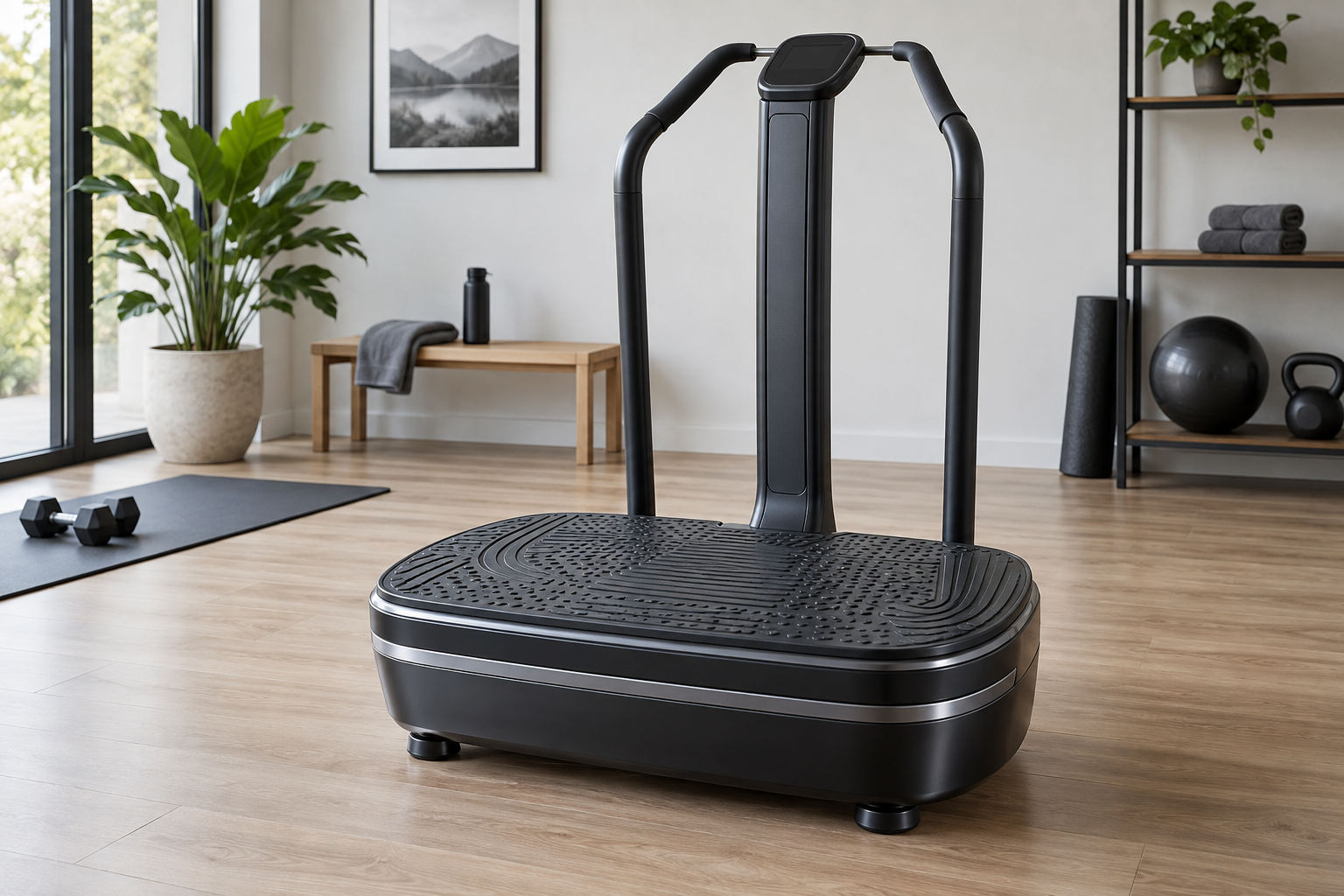
Power Plate
Power Plate MOVE Professional Vibration Platform
An upright professional-style platform for buyers who value integrated hand support.
A vibration plate and a balance board may occupy similar floor space, but they train different tasks. The powered plate moves beneath the user at a selected setting. The unpowered board tips or rolls in response to the user's weight shift. Plate sessions emphasize exposure to repeated movement; board practice demands active control of an unstable surface.
On a plate, the motor initiates motion and the user maintains posture. On a board, the user initiates and corrects every tilt. The board therefore provides direct balance-skill feedback, while the plate can support standing holds, squats, bands, or short warm-ups with repeatable powered input.
Neither should be described as a substitute for all strength, walking, or mobility work.
Choose the board for deliberate balance practice, ankle-control drills, sport-oriented weight shifting, low price, silent operation, and storage without power. It also wins when the user wants the challenge to respond instantly to technique rather than a motor setting.
A rail, counter, or trained supervision may be appropriate because the board can tip unexpectedly.
Choose the plate for powered oscillation, timer-based standing sessions, resistance-band combinations, and users who prefer a broad base rather than a freely tipping board. A handled plate can offer additional entry support, though the surface is still moving.
It requires power, creates noise, and costs more. Floor transmission matters in apartments.
If the program already includes walking and strength but lacks balance practice, the board is the focused addition. If the buyer specifically wants whole-body vibration and will use its movement modes, the plate fits. Owning both is reasonable only when each has a distinct scheduled role.
Compare space around the equipment and the user's ability to step off safely.
Balance-board difficulty changes through board geometry, fulcrum shape, stance, support, and the movement attempted. Progression might mean using less hand support, controlling a greater tilt, or adding a slow task while keeping the edges off the floor. The user creates the motion and receives immediate feedback when control slips. This makes the board well suited to deliberate skill practice, but also creates a clear fall risk if the chosen variation exceeds ability.
Vibration-plate progression uses different variables: motor mode, controller setting, stance distance from the pivot, posture, duration, and exercise. The plate’s broad feet should remain on the floor; the challenge comes from maintaining position while the deck moves. Progression can occur without increasing speed by improving a squat or adding a controlled band movement. A nearby support and reachable stop remain useful even though the base does not intentionally tip.
Floor requirements differ. A balance board needs clearance for its edges or roller and can damage a delicate surface without a suitable mat. A vibration plate needs a firm, level base and may transmit sound through the building. The board stores without a cord or remote; the plate may be heavier but offers timed powered sessions. In a small upstairs apartment, these practical differences can outweigh the exercise catalog.
A buyer with an existing balance limitation should not infer that either device is automatically therapeutic. The free-tipping board may be too unstable, while powered vibration can also disrupt stance. Individual professional guidance may be appropriate. Product marketing phrases such as balance support do not describe the level of challenge for a particular person.
Cost comparison should include the support environment. A balance board is inexpensive and needs no electricity, but a suitable mat and stable rail may be necessary. A vibration plate costs more and may need a dense equipment mat, nearby outlet, and replacement remote or bands. List the complete setup for each. The simpler product is not automatically the simpler experience when the user needs additional help to enter or control it.
As an Amazon Associate, we may earn from qualifying purchases.
An upright professional-style platform for buyers who value integrated hand support.
The balance board wins for active instability and technique-driven balance work. The vibration plate wins for powered, repeatable movement with broader exercise options. Choose the tool that supplies the missing task rather than the one with the longer feature list.
Continue the Vibration Plate vs Balance Board decision in the full product catalog, brand directory, or vibration plate finder.