AXV
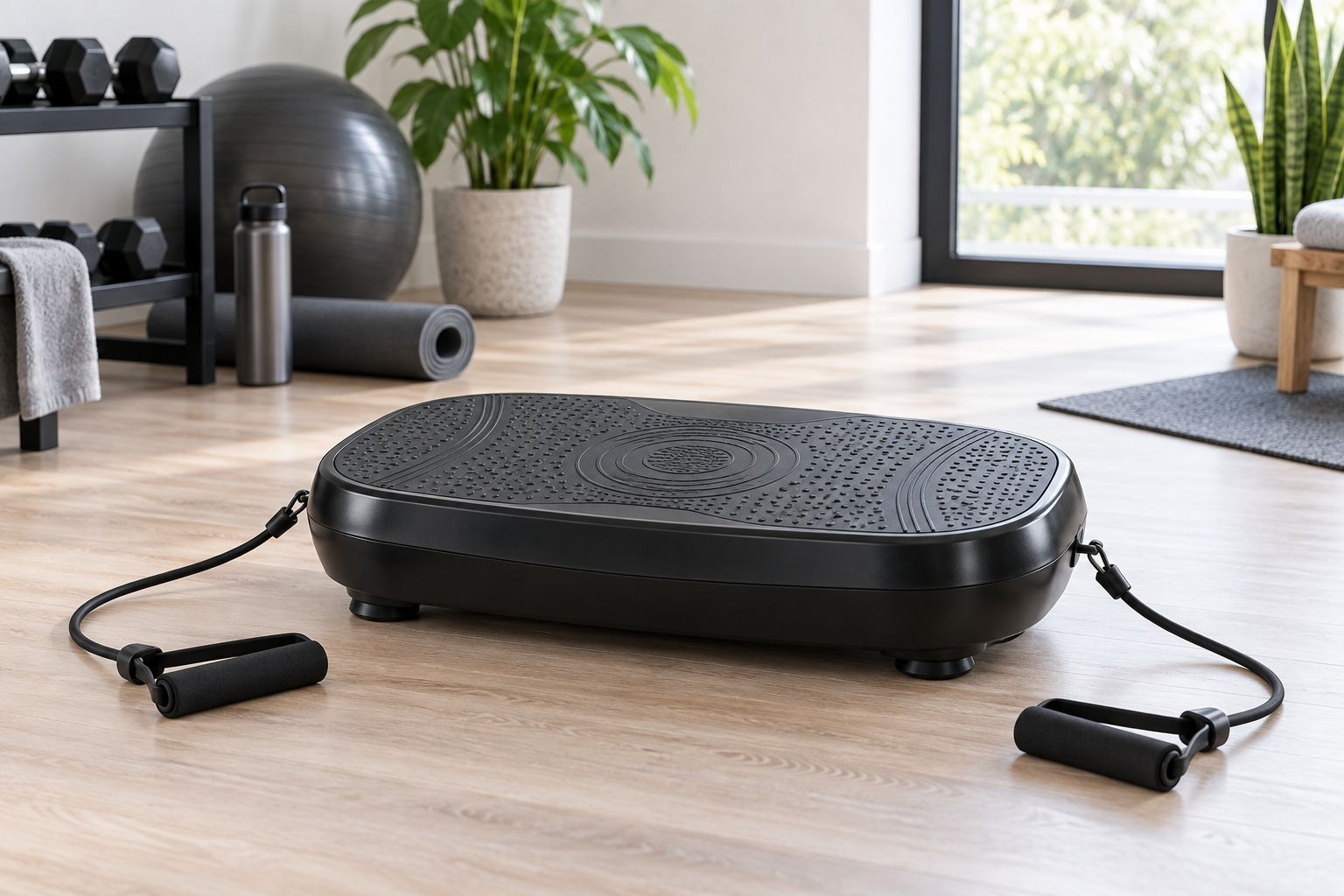
AXV Curved 200W Bluetooth Vibration Plate
A curved compact plate with a 200-watt motor and Bluetooth-listed configuration.
Whole-body vibration describes use: a person stands, sits, or supports part of the body on a powered platform so repeated movement travels through the contact point. The name does not identify one motor design. A compact oscillating plate, vertical commercial platform, and multi-axis home unit may share the phrase while producing different movement.
Side-alternating platforms pivot around a center. Linear platforms move the deck more uniformly, commonly vertically. Multi-axis products combine patterns or add a second motor. These distinctions affect stance, balance demand, and how research relates to a product. A study on a supervised vertical platform cannot automatically validate every consumer oscillating model.
Ask for motion direction, frequency in hertz, displacement, and control method. A large number of programs does not replace those basics.
Knee angle, footwear, stance width, hand placement, and body position change transmission. Soft knees can reduce movement reaching the head during standing. Placing hands on the deck for a plank changes contact and loading entirely. The machine supplies motion; posture determines much of the experience.
Session guidance should therefore name a position. A duration without mode, setting, stance, or exercise is incomplete.
Compact home plates emphasize storage, remotes, bands, and price. Larger commercial systems may offer handles, calibrated controls, greater mass, or supervised protocols. A home buyer does not necessarily need commercial size, but should recognize when a claim comes from equipment with different specifications.
Measure operating area rather than stored footprint. Users need room to step on safely, reach support, attach bands, and move around the deck.
A shopper seeking brief standing sessions may favor a broad oscillating deck. Someone following a defined protocol needs the same motion and measurable settings used by it. A household moving the unit after every session should prioritize machine weight and handholds.
Capacity should include a comfortable margin, and the floor must support a stable base. Test noise where it will operate because wood framing can transmit vibration beyond the room.
When an article cites a study, compare the research device with the plate being considered. Look for platform direction, frequency, displacement or amplitude, session length, posture, supervision, and participant group. A finding from trained adults using a vertical commercial unit does not establish the same outcome for every person standing on a compact oscillating model. The phrase whole-body vibration connects a category of equipment; it does not make the equipment interchangeable.
Health-related buyers should also separate a product feature from a treatment claim. A timer, handle, or gentle setting may make a machine easier to use, but it does not show that the plate treats swelling, osteoporosis, neuropathy, or another condition. Someone with an implanted device, recent surgery, pregnancy, significant balance limitation, or a medical concern should get individualized guidance before using powered vibration. The product manual may list additional exclusions specific to the model.
For general home exercise, define a modest, observable job: provide a stable platform for short standing sessions, add movement to a shallow squat, or support a brief band circuit. Then select a machine that performs that job with clear controls and enough room. This keeps the purchase tied to behavior the owner can repeat. Broad promises about circulation, detoxification, or effortless weight loss should never substitute for a usable equipment specification.
The first week should function as an equipment trial. Use the same conservative posture several times and record stability, control access, noise, and any reason the session ends early. Then add one planned exercise at a time. If the machine cannot perform its basic assigned task comfortably at the low end, preset variety will not repair the mismatch. Return decisions should follow those observations while the window remains open.
As an Amazon Associate, we may earn from qualifying purchases.
A curved compact plate with a 200-watt motor and Bluetooth-listed configuration.
Treat whole-body vibration platform as a broad equipment class. Identify motion, measurable range, deck, controls, and intended body position before comparing brands. A useful machine reproduces the chosen task conveniently rather than merely carrying the broadest label. Keep the model-specific manual with the training notes so later settings remain tied to the correct equipment.
Continue the Whole-Body Vibration Platforms: Home Models vs Commercial Machines decision in the full product catalog, brand directory, or vibration plate finder.